
RAM BCI: Businesses still pessimistic about their three-month outlook in 2Q 2025
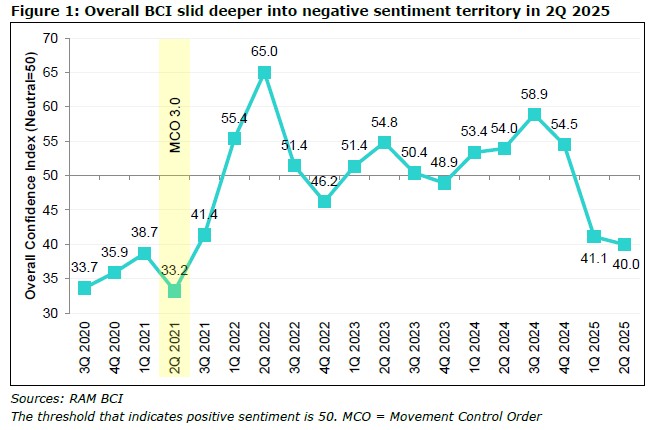
The RAM Business Confidence Index (BCI) dropped further to 40.0 in 2Q 2025 (1Q 2025: 41.1). This marks the second consecutive quarter of negative sentiment on business prospects, which aligns with the rapidly escalating risks in global trade stemming from rising US protectionism policy. Three out of five sub-indices declined Q-o-Q, namely sales, capital investment and capacity utilisation.
Consistent with the overall cautious and subdued business outlook, rising cost of doing business remains the most pressing issue, with 80% of firms citing it as top concern. More competition and weak economic conditions also pose significant hurdles, with 63% of firms identifying them as key challenges. The share of firms citing supply chain issues also jumped 11 percentage-points to 40% in this survey.
Impact of US tariffs under spotlight
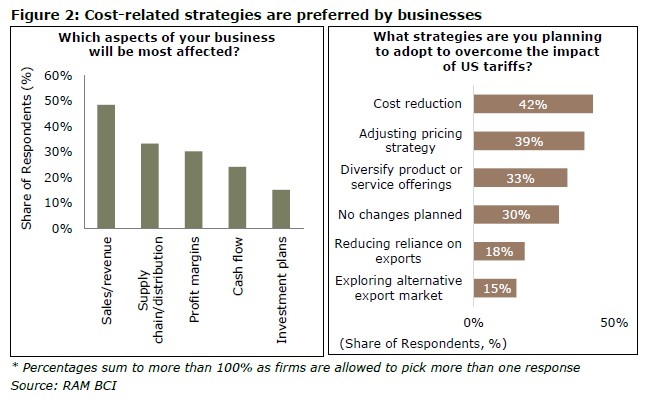
A special focus for this quarter’s survey, which was conducted from 29 May 2025 to 28 June 2025 polling 33 firms, was the impact of the US tariffs on Malaysian goods. Around two-thirds of firms surveyed anticipate a negative impact from these tariffs, of which a significant 27% of firms expect a major negative impact, with firms anticipating moderate and minor impact each at 18%. Sales and revenue topped the list of business aspects likely to be hit, followed by profit margins, supply chains and cash flow.
In response, firms are mainly adopting cost-related strategies to mitigate tariff impacts. About 42% are focusing on cutting operational expenses, while 39% are adjusting pricing strategies to remain competitive.
Demand for government support
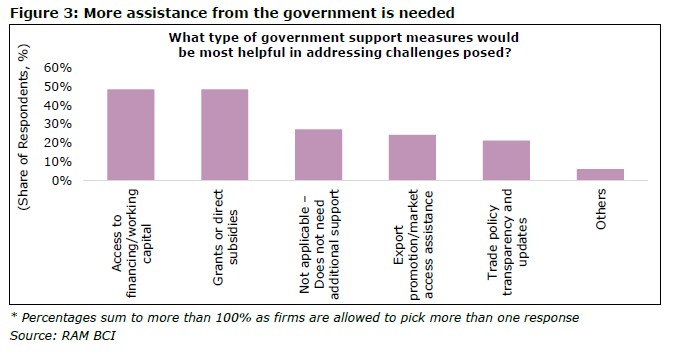
Businesses are calling for more assistance from the government, especially in terms of better access to financing and working capital. Grants and direct subsidies are equally in demand to help offset the challenges posed by trade tensions.
The latest RAM BCI survey highlights the growing pressures Malaysian businesses face from rising costs, intensified competition and external trade disruptions such as US tariffs. Chris W.K. Lee, RAM Holdings Berhad Group CEO and Executive Director said, “While businesses remain cautious, it is encouraging to see that companies are still investing and hiring. It is crucial that government and industry stakeholders work together to respond to the new challenges for businesses to survive and thrive.”
Comments