
Execution remains key for 13th Malaysia Plan
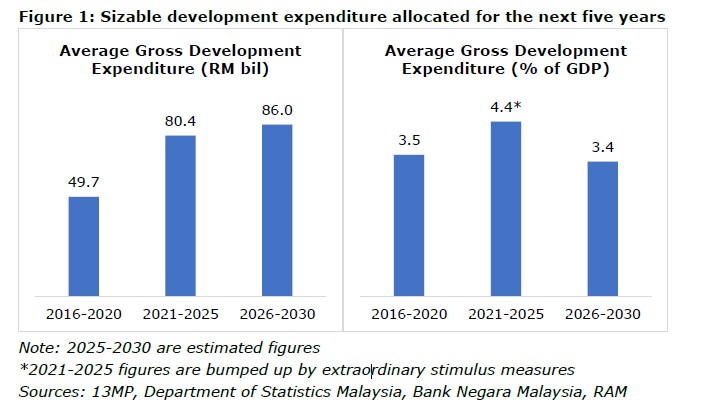
The recently tabled 13th Malaysia Plan (13MP) continues the government’s dual-focus approach of fiscal consolidation alongside sustained support for growth. The headline development expenditure (DevEx) allocation of RM430 bil over five years represents a marked step-up in investment. This translates to an average allocation of RM86 bil per annum from 2026 to 2030, well above the RM79 bil annual average recorded from 2021 to 2024 and nearly double the pre-pandemic average of RM48 bil between 2015 and 2019. Spread evenly, this roughly works out to the government spending at least 3% of GDP on DevEx each year, with more than half of the total allocation (52.8%) directed to the economic sector. This should underpin the much needed infrastructure build-out, human-capital development and innovation-driven projects under the 13MP.
Realistic Growth Ambition
The plan targets an average annual GDP growth of 4.5%–5.5% over 2026–2030, a range close to the 5.2% average growth recorded between 2021–2024. We believe that this target is both realistic and achievable, and is also similar to our baseline medium-term GDP growth expectation of circa 5.0%, provided global headwinds remain manageable and domestic policy support continues.
Fiscal Consolidation Remains on Track
The 13MP reiterated its commitment to narrow the fiscal deficit to below 3% of GDP by 2030, from the 4.1% recorded in 2024. Assuming the total development expenditure is somewhat evenly spread across 2026–2030 and real GDP grows within the targeted range of 4.5%–5.5%, the deficit ratio should be on track to decline toward the sub-3% objective.
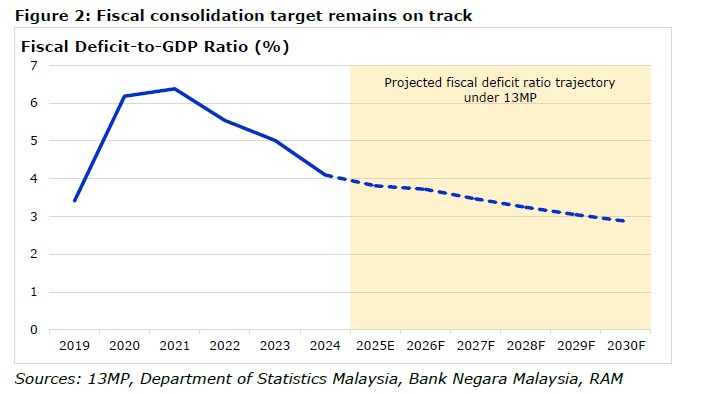
This fiscal consolidation is important to help lower the government’s debt load, which climbed to 64.6% of GDP as at end-2024 from 52.4% in 2019, and in turn ease its debt-servicing burden. Interest payments reached 15.6% of government revenue as of end-2024, up from 12.5% in 2019, which suggests that for every RM100 in government revenue earned, about RM16 is used to pay interest on borrowing. Sustained deficit reduction, therefore, helps avoid the crowding out of productive spending and frees up resources for development priorities over the long run.
Human-Capital and Income Targets
The 13MP aspires to raise compensation of employees (CE) to 40% of GDP by 2030, a commendable target in order to resolve Malaysia’s widely talked about issue of ‘stagnant’ wages. However, this would require an average annual CE growth of 11.1% between 2026 and 2030, more than double the 5.3% pace under the 12MP and higher than the pre-pandemic (2016-2019) average of 7.1%. With CE share at only 33.6% in 2024, achieving this will demand effective wage policies, including continued minimum-wage adjustments, stronger graduate and TVET wage progression, and broad-based productivity enhancements.
The Plan also addresses investments in human capital and preparation as the nation transitions into an aged nation. Latest projections by the Department of Statistics Malaysia indicate that the country will transition into an “aged society” by around 2050, with the working-age population share expected to fall from 70% in 2025 to 68%. Coupled with declining birth rates (total fertility rate of 1.7 in 2023 versus 2.0 in 2013), Malaysia faces a shrinking labour force. The review of the mandatory retirement age, alongside a comprehensive strategy for workforce upskilling and an emphasis on Technical and Vocational Education and Training (TVET) to address skill mismatch issues under 13MP, should help mitigate some of the labour market challenges ahead.
Execution Remains Key
As with previous plans, execution remains the linchpin. The enhanced Policy Implementation Plan and monitoring system known as MyRMK will oversee integrated implementation across ministries. The enhanced transparency, which enables timely course corrections, provides the necessary tools for success. Whether the 13MP targets can be met will depend heavily on the effectiveness of execution and the discipline to follow through with the plans.
The 13MP strikes a prudent balance between fiscal consolidation and growth support, with a sizeable and well-targeted DE envelope and a realistic growth target. While sectoral allocations and digital-innovation drivers are well calibrated, execution capacity and human-capital challenges, particularly the ambitious income share goal, will be decisive. Strong implementation governance, more effective measures to minimise leakages and ensure efficient use of public funds, coupled with supportive policies for wages and innovation, will be critical to realising the 13MP’s 2030 vision.
Comments