
A Vast Majority of Businesses Have Established Sustainability Targets with More than Half Still Using Manual Tools for Measurement
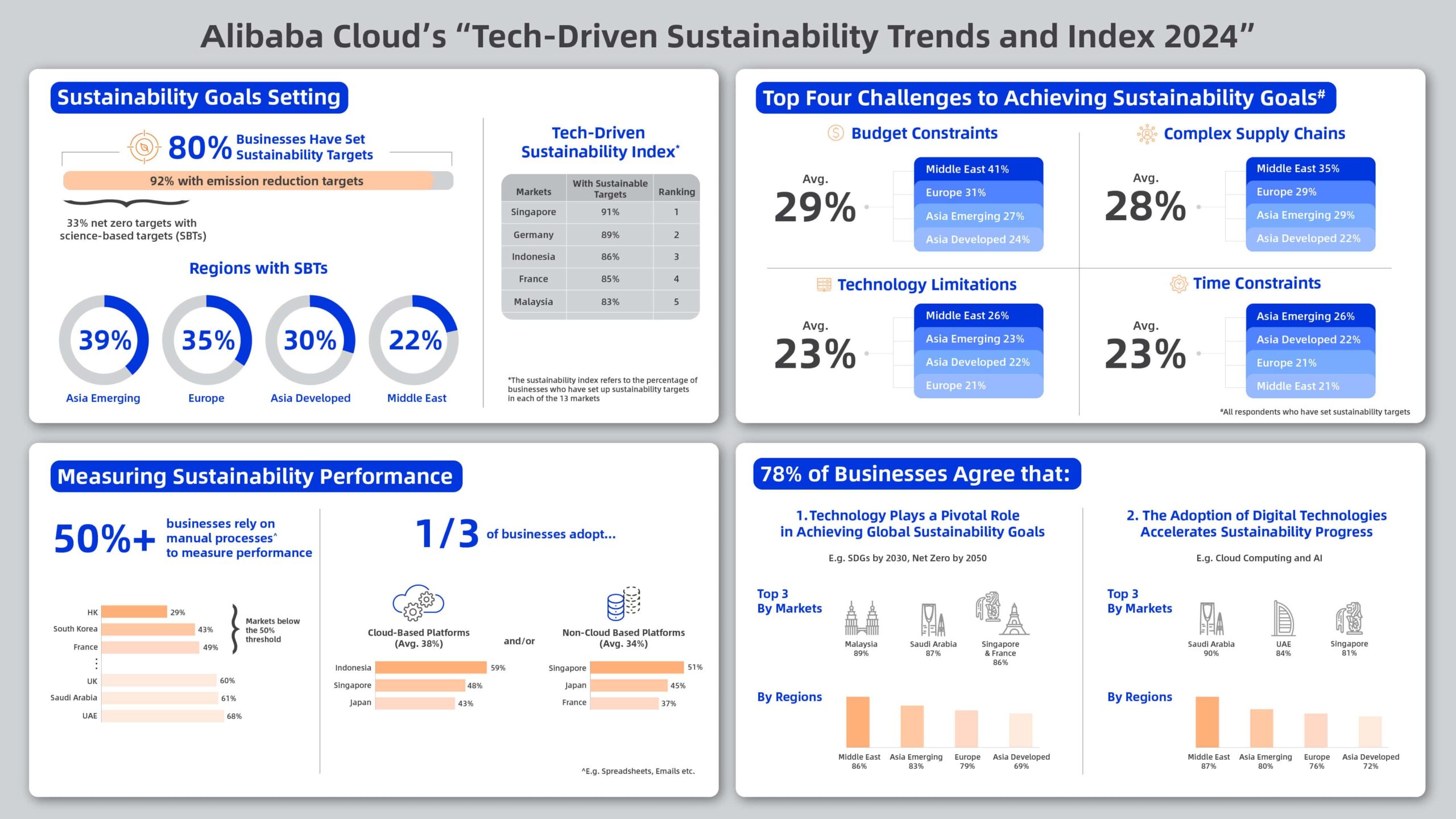
Kuala Lumpur, Malaysia, October 21, 2024 – A significant 80% of businesses surveyed across Asia, Europe and the Middle East have established sustainability targets. However, more than half (53%) of those businesses continue to rely on manual methods for measuring their progress, with Malaysia mirroring this trend with 56% of Malaysian businesses continue to use manual processes according to a survey report titled “Tech-Driven Sustainability Trends and Index 2024” commissioned by Alibaba Cloud, the digital technology and intelligence backbone of Alibaba Group.
The report reveals that among businesses with sustainability targets, 92% have set emission reduction targets. However, only one-third of these organisations have committed to net-zero commitments with science-based targets (SBTs). The highest adoption of SBTs is in emerging Asian markets at 39%, followed by Europe at 35%, developed Asian markets at 30%, and the Middle East at 22%
Around half of the businesses with sustainability targets cite driving growth (56%), compliance with regulations (54%), and a strong corporate purpose (49%) as their key motivations for establishing targets. Notably, among all markets, Indonesia tops the list with 70% of businesses prioritising growth, Saudi Arabia leads with 73% emphasising compliance, and the UAE excels with 61% prioritising a strong corporate purpose.
A significant 78% of businesses agree that technology is crucial for achieving global sustainability goals, with top markets including Malaysia (89%), Saudi Arabia (87%), Singapore (86%) and France (86%). Regionally, this belief is strongest in the Middle East (86%) with emerging Asian markets a close second (83%). Similarly, 78% believe that adopting digital technologies such as cloud computing and AI will accelerate progress toward meeting sustainability goals, with Saudi Arabia leading at 90%, followed by the UAE (84%) and Singapore (81%).
Market Commitment Levels and Challenges
When assessing market commitment levels, Singapore ranks highest with an impressive sustainability index of 91%, followed closely by Germany at 89% and Indonesia at 86%. Malaysia, in fifth place, has 83% of businesses setting sustainability targets. The sustainability index refers to the percentage of businesses that have established sustainability targets in the 13 markets.
Businesses encounter various barriers in meeting their sustainability targets. Budget constraints emerge as the most significant obstacle, affecting 29% of organisations, particularly pronounced in the Middle East (41%) and Europe (31%). Complex supply chains further complicate efforts, impacting 28% of businesses, especially in the Middle East (35%) and Europe (29%). Additionally, technology limitations hinder 23% of companies, with the Middle East facing a slightly higher rate at 26%. Time constraints also present significant challenges across all regions, affecting 23% of organisations. For those yet to set sustainability targets, budget constraints (32%) and technology limitations (29%) remain the primary barriers to meeting sustainability targets.
Reliance on Manual Measurement
As businesses strive to enhance their sustainability efforts, the necessity for effective digital tools is evident. The survey emphasises the necessity for businesses to improve their understanding of digital tools, as 59% of respondents acknowledge a gap in their knowledge regarding how technology can help achieve sustainability goals. This sentiment is particularly evident in Singapore (83%), Hong Kong (75%) and Thailand (70%).
The report also shows a general reliance on traditional practices among businesses, which may present challenges in effectively achieving sustainability goals. In Malaysia particularly, the study indicated that 56% of businesses depend on manual processes to measure sustainability performance using spreadsheets, emails, and similar methods. All markets, except for Hong Kong (29%), South Korea (43%) and France (49%), exceeded the 50% threshold, with the highest percentages in the UAE (68%), Saudi Arabia (61%), and the UK (60%). Meanwhile, only around a third of businesses use digital software tools including cloud platforms for the sustainability progress and measurement. Indonesia (59%), Singapore (48%) and Japan (43%) demonstrate a higher adoption of cloud-based solutions, while the average usage is at 38%.
“The survey findings underscore the urgent need for organisations to reassess their sustainability measurement methodologies and embrace advanced technological solutions like cloud-based platforms and AI services. These digital tools not only streamline the measurement process but also provide actionable insights that can drive meaningful progress for sustainability,” said Selina Yuan, President of International Business, Alibaba Cloud Intelligence.
“As a dedicated cloud service provider, we are committed to providing innovative and AI-powered solutions such as Energy Expert to enable enterprises to effectively measure and analyse carbon emission and energy consumptions to advance their sustainability goals. By addressing existing barriers and investing in such advancements, organisations can better align their sustainability initiatives with established targets,” she added.
“Tech-Driven Sustainability Trends and Index 2024” aims to provide valuable insights into the evolving landscape of corporate sustainability while highlighting how technology can be applied to drive impactful change.
About the Survey
Alibaba Cloud’s “Tech-Driven Sustainability Trends and Index 2024” was independently conducted by Yonder Consulting, a UK-based consulting firm, with advisory, design and analytical support from The Purpose Business, an Asia-based sustainability consultancy with offices in Hong Kong and Singapore. The survey collected feedback from May 10 to June 19, 2024, involving 1,300 business leaders and senior management from various industries, including technology and communications, finance, infrastructure, renewable resources, healthcare, transportation, retail, and manufacturing.
Respondents were located across 13 markets in Asia (Malaysia, Indonesia, the Philippines, Thailand, Hong Kong SAR, Japan, Singapore and South Korea), Europe (France, Germany, and United Kingdom), and the Middle East (Saudi Arabia and UAE). In this survey, developed Asian markets refer to Hong Kong SAR, Japan, Singapore, and South Korea, while emerging Asian markets include Indonesia, Malaysia, the Philippines, and Thailand.
About Alibaba Cloud
Established in 2009, Alibaba Cloud (www.alibabacloud.com) is the digital technology and intelligence backbone of Alibaba Group. It offers a complete suite of cloud services to customers worldwide, including elastic computing, database, storage, network virtualization services, large-scale computing, security, big data analytics, machine learning and artificial intelligence (AI) services. Alibaba has been named the leading IaaS provider in Asia Pacific by revenue in U.S. dollars since 2018, according to Gartner. It has also maintained its position as one of the world’s leading public cloud IaaS service providers since 2018, according to IDC.
Appendix: Key survey findings
Technology’s Role in Sustainability:
- 78% of businesses agree that technology plays a pivotal role in achieving global sustainability goals, and the adoption of digital technologies can accelerate progress.
- 89% of Malaysian businesses agree that technology plays a pivotal role in achieving global sustainability goals. This highlights a strong recognition of the importance of digital solutions in driving sustainability efforts in the country.
Understanding of Digital Technology:
- 63% of businesses from Asia acknowledge a gap in understanding how digital technology can aid in achieving sustainability goals. This suggests that while there is recognition of the importance of technology, there may be a need for more education and resources to bridge this gap.
- 56% of Malaysian businesses still use manual processes to measure and track sustainability performance and only a third use cloud and/or non-cloud tracking software/application platforms.
These findings indicate that while there is a strong belief in the role of technology for sustainability in Malaysia, there are also challenges related to understanding and adoption that need to be addressed to fully leverage these digital tools.
Comments