

Allianz has recently unveiled the first edition of its ‘Global Pension Report’, taking the pulse of pension systems around the world with its proprietary pension indicator, the Allianz Pension Indicator (API).
The indicator follows a simple logic: It starts the analysis with the demographic and fiscal prerequisites and then continues to examine pension systems along their two decisive dimensions: sustainability and adequacy.
Hence, it is based on three pillars and takes in all 30 parameters into account, which are rated on a scale of 1 to 7, with 1 being the best grade. By adding up all weighted subtotals, the API assigns each of the analyzed 70 countries a grade between 1 and 7, thus providing a comprehensive view of the respective pension system.
“Demographics and pensions have been eclipsed by other policies in recent years, first and foremost climate change and today the fight against Covid-19,” said Allianz chief economist Ludovic Subran.
“But you ignore demographics at your own peril, demographic change will soon be back with a vengeance. Defusing the looming pension crisis and preserving generational justness and equality are key for building inclusive and resilient societies.”
Dramatic Shifts in Demographics

The dramatic shift in demographics is best characterised by the increase in the global old-age dependency ratio: until 2050, it will grow by a whopping 77% to 25%, i.e., faster than in the last 70 years since 1950.
In many emerging economies the ratio is going to more than double within the next three decades, that is, in less than half of the time this development took in Europe and Northern America.
The most prominent example is China where the ratio is going to increase from 17% to 44%. For industrialised countries, however, the absolute level of this ratio is the main reason for concern, reaching, for example, 51% in Western Europe.
This development is reflected in the first pillar of the API, called the starting points, which combines demographic change and the public financial situation (financial leeway).
Not surprisingly, many emerging countries in Africa score rather well as the population is still young and public deficits and debts are rather low. On the other hand, many European countries such as Italy or Portugal are among the worst performers: old populations meet high debts.
“For most industrialised countries, the old Scottish joke applies: If I were to build a stable pension system, I certainly wouldn’t start from here,” said Michaela Grimm, author of the report.
“And that is the situation before the coronavirus and its tsunami of new debt. One of the legacies of the current crisis will certainly be that we have to double our efforts to reform our pension systems. What remained of financial leeway has gone for good.”
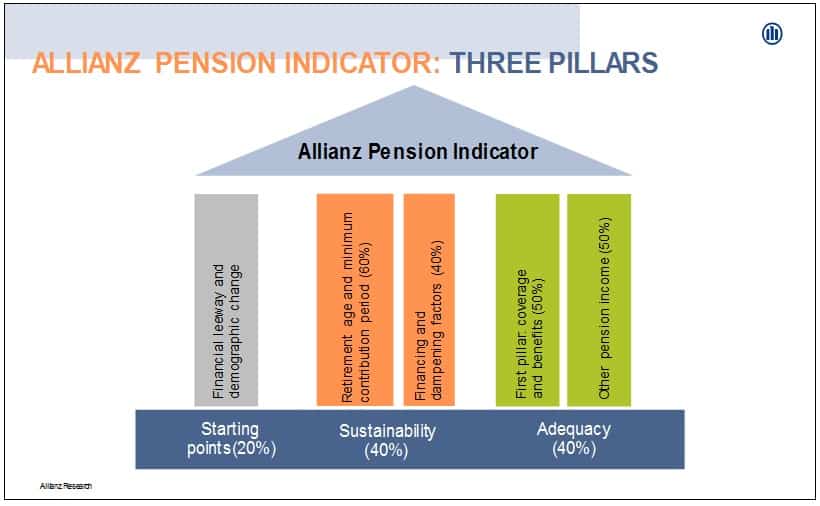
The second pillar of the API is sustainability, measuring how systems react to demographic change: Are there built-in stabilizers or will the system be blown apart when the number of contributors falls while that of beneficiaries keeps rising?
In that context, an important lever is the retirement age. In the 1950s, an average 65-year old men, living in Asia could expect to spend around 8.9 years in retirement (women 10.3 years).
Today, the average further life expectancy of a 65-year old is 17.8 years for women and 15.2 years for men and it is set to increase to 19.9 years (women) resp. 17.5 years (men) in 2050.
As a consequence, the ratio of working life to time spent in retirement has declined markedly. Countries, which decided to adjust the legal retirement age or the increase of pension benefits to the development of further life expectancy like the Netherlands, have thus a more sustainable pension system than countries where postponing retirement further is still taboo.
The third pillar of the API rates the adequacy of the pension system, questioning whether pension systems provide an adequate standard of living in old age.
Important levers are the coverage ratio – i.e. how big are the shares of the working-age population and the age group in retirement age that are covered by the pension system? –, the benefit ratio – i.e. how much money (measured in terms of average income) does an average pensioner receive? –, and last but not least the existence of capital-funded old-age provision and other sources of income.
Overall, the average score in the adequacy pillar (3.7) is slightly better than that in the sustainability pillar (4.0), a sign that most systems still put greater weight on the well-being of the current generation of pensioners than on that of the future generation of tax and social contribution payers.
The countries leading the adequacy ranking have either still rather generous state pensions, like Austria or Italy, or strong capital-funded second and third pillars, like New Zealand or the Netherlands.
However, capital-funded retirement solutions are under increasing pressure in the persisting low-interest rate environment. The COVID-19 pandemic has further exacerbated this trend by further pushing down yields.
“The low yield environment has forced both pension funds and life insurers to explore alternative asset classes,” said Allianz SE head of global retirement proposition Cameron Jovanovic.
“This push into alternatives enables benefit providers to capture the illiquidity premium that matches well with their portfolio duration. Another strategy is to offload risk rather than chasing returns as longevity swaps, pension risk transfers and creative reinsurance set-ups become means of optimizing the exposure taken on by pension funds and insurers.”
Top 10 Pension Systems Worldwide

Top 10 Pension Systems in Asia