There is a prolonged debate on the superiority of both analyses, or in short: fundamental analysis vs technical analysis. I can recall my days as a derivatives dealer where some clients prefer to read news, while others like to draw charts.
But for sure both types of analyses have their own merits as it measures the price trajectory of the markets.
What Is Fundamental Analysis?
Fundamental analysis refers to analysing the information from the news and reports. The investors will assess the information in hands and make attempts to predict the direction of the asset’s price.
What Is Technical Analysis?
The technical analysis on the other hand is a price action strategy. The investors will evaluate the market breadth based on the readings of price trend patterns, indicators and oscillators; then draw a conclusion on future market sentiment. So, based on the definition, which is more appropriate and why?
The news have heterogeneous impacts on the financial markets. A group of markets may receive the same news, but the investors will react differently. The COVID-19 news for instance, may trigger a bearish sentiment but the magnitude of impacts on the financial markets in the developed and emerging markets will be different. Therefore, it is crucial that the investors to understand how the asset price in their portfolio moves.
According to the empirical finance, generally there are three main stages of asset movement which are called information arrival, co-movement and volatility. At the stage of information arrival, investors receive and react on the information upon receiving them.
In the second phase, the asset influences the other assets or markets. Next, when there is the absence of news, but the price is constantly moving, we call it the stage of volatility.
Fundamental Analysis vs Technical Analysis
To decide on when to use the fundamental or technical analyses, the investors need to know their portfolios well such as the sensitivity to news and the movement of interrelated markets. Applying the fundamental analysis needs a good knowledge of portfolio sensitivity.
The best example is the stock’s beta to index. The fundamental analysis is best to use in the first and second stage. While some commodity markets like energy and agriculture futures, the investors are depending on the EIA and USDA reports however the information on production numbers and demand will not being released so frequently.
In this case, it is preferably to use fundamental analysis to determine the market sentiment thereafter technical analysis is used to time the entry and exit.
By and large, fundamental and technical analyses are tactical in investment and trading. The investors should assess the market sentiment based on the news, and time their entry using the price charts. It is worth to note that regardless of trends, either bearish or bullish, the price will not move linearly.
There must be the phases of corrections, retracement, rebounds and reversals amidst of the major trend. The news may set path for the major trend, but the trading motivations of buyers and sellers determine the intertemporal price dynamics.
So in the case of fundamental analysis vs technical analysis, which one do you prefer? They say if you are an investor, then you should use fundamental analysis. If you are a trader, then you should be using technical analysis. Or can we use both?
About the Author
Dr. Ahmad Danial is a Certified Financial Technician (CFTe) and Senior Lecturer in Finance at Department of Economics and Financial Studies, UiTM Puncak Alam. He has over 10 years’ experience in the financial markets before hopping into the academia. His areas of expertise include financial contagion, trading in stocks and derivatives markets, price discovery, hedging strategy, Econophysics and technical analysis. He can be reached at danialzainudin@uitm.edu.my.
The following story is based on an actual series of events with some names and circumstances fictionalised and any similarity to the name, character or history of any person is entirely coincidental and unintentional. With it, hope that we can understand more about why family business fail.
It was unexpected for Jade. Her late husband, Chee’s family business empire had just fallen in the hands of others!
How wrong Jade was with her assumption that when it came to the crunch, her late husband’s two partners would be sympathetic towards her. Instead they teamed up to make sure that not only she had no say in the business but also for her two estranged step-sons from her late husband’s first marriage.
The two partners combined their equity holdings to ring-fence control and totally keep out the family of late founder Chee (Jade’s late husband) as they were worried and felt strongly that the ensuing family conflicts between Jade and her late husband’s family from his first marriage would be disruptive to the business.
The partners had the advantage of the split equity holding of the Chee family members to stage a takeover of control of the business. Jade had never thought the partners would betray her as they were very supportive of founder Chee, and also empathised with her when they saw how terrible the step-sons treated her after their father passed on.
The partners consoled Jade many times and offered to help in anything. She had the feeling that they would not be inclined to bring the step-sons into the business. She also reckoned that they would not be averse to appointing her as Director of the company so as to maintain the Chee family interest. However, all those so-called partners were fake. Eventually the partners took control of Chee’s family business empire and kicked her out.
How Easily A Family Business Fail
How could Jade’s late husband not foresee this? It became clear to Jade now that her late husband was good in running the business but he had failed miserably in ensuring continuity of the family business empire that he so capably built.
While Jade’s late husband knew of Jade’s capabilities as a successor, he had not planned for it. He had not been communicative and shared with her anything to do with the business. He had been going about in the prime of his life as if he was immortal. And that probably was the reason why he didn’t even have a will!
Only after the cruel blow of being killed in an accident following a drinking session with business associates that Jade found out that her late husband was actually not in control of things, especially his business empire. He was so ill prepared.
Without a will, her late husband’s assets would, according to the intestacy law, be distributed to his parents, spouse and children. Effectively without surviving parents, his estate which included his majority shareholding in the family company is split between Jade and his two sons from the first marriage. That means not only his business but the house that Jade is staying is now co-owned by her step-sons too!
But being on unfriendly terms, the fragmented shareholding of the Chee family members delegated them to be minority shareholders. By not combining their shareholding, they could not match, out-vote and block the combined controlling power of the two partners. What a tragedy!
The Importance Of Succession Planning
Proper succession planning would have ensured smooth continuity of management, control and ownership of a family business. If not, the chances for the family business fail will increase.
It is prudent that succession planning starts as early as possible to avert a situation like the unwanted outcome of the Chee family business. Consult experts in estate planning to make sure a succession plan is achievable and will not have unforeseen pitfalls, even of tax and financial nature.
A viable solution would be a Business Trust which creates a structure for family succession. Through instructions in the trust deed from the owner, the Business Trust can be designed to benefit the family members to ensure the continuity and preservation of the business within the family, even for those who are not on good terms with each other.
Contentious issues such as successor -be it a family member or a business partner – and the delegation of powers could be pre-determined and stipulated in the Business Trust for the appointed Trustee, which is recommended to be a licensed trust company that operates in perpetuity, to carry out the instructions.
Other relevant matters that could be addressed could include triggering event, for example, death, illness, incapacity or disappearance; or legal considerations that include exit arrangements or buy-sell arrangement of shares by other existing partners/shareholders from family shareholders; and also succession structure and process.
With such proper estate planning that also encompasses protection of beneficiaries from unwarranted or future claims from creditors or ex-spouses, or takeover attempts by unfriendly parties, or even possibility of squandering of inheritance by beneficiaries, nothing is left to chance and the interest and future of one’s family business would be safeguarded.
Such comprehensive estate planning solutions can be achieved by consulting an experienced estate planner working with an established company such as Rockwills Trustee Berhad.
About Rockwills International Group
Rockwills International Group, now in its 27th year, pioneered professional will writing in 1995 and has since evolved into the leading estate planning specialist in the country. It is today the largest provider of solutions and support services in the areas of trusts, succession, management and distribution of wealth. It has shareholders’ funds exceeding RM50 million. It has done over 280,000 wills and 15,000 trusts and hold more than RM25 billion in assets under trust.
There are four money personas found across Malaysia according to new research from Wise, a global technology company building the best way to move money around the world, which uncovered that almost half of Malaysians polled are avid shoppers, or “Shopping Pros”, making up 49% of survey respondents, while budgeting geniuses “Financial Controllers” are 38%.
Hidden fee finders “Aunty Powers” are a smaller group at just 12% of Malaysians surveyed, followed up by value driven buyer “Kopitiam Uncles” representing a mere 1% of respondents.
While Shopping Pros and Financial Controllers clearly dominate, Wise’s Don’t Kena Con campaign, which looked to uncover how “wise” Malaysians are with their spending, has determined the majority of Malaysians still have much to learn from Aunty Powers and Kopitiam Uncles on understanding hidden fees and markups while undertaking shopping adventures.
In fact, over one-third (37%) of Malaysian respondents who shop online and spend overseas note they have no idea what the fees and exchange rates are until the transaction is complete. That said, Malaysians show off an impressive understanding of currency exchange, with 60% reporting they know what the mid-market rate is.
Cost-conscious behaviour among Malaysians spurring need for transparency
Aunty Powers and Kopitiam Uncles who seek truth and cost transparency may only make up a small part of the population now, but they’re showing off some influence in Malaysians looking to better understand currency conversions.
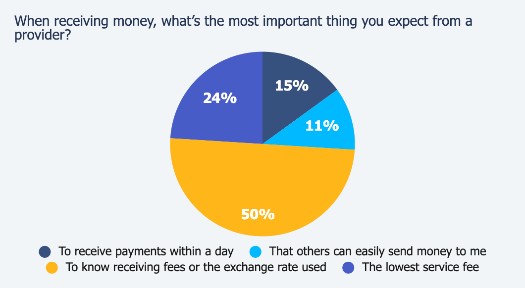
More than half (52%) of all Malaysian respondents have the impression that fintech platforms give the best rates when it comes to foreign exchange, although 38% chose money changers. This may be to their detriment, as half (50%) of Malaysians surveyed want to know if the remittance provider charges a receiving fee or the exchange rate used when receiving money from overseas.
Plus, close to a quarter of respondents (24%) said having the lowest service fee was the second most important thing they expect from a remittance provider.
Given the Aunty Power’s ability to sniff out the prawn behind the rock, many Malaysians still have a lot to learn when it comes to understanding hidden fees, and it’s clear that transparency in fees is something consumers are increasingly looking for.
An earlier independent research commissioned by Wise[1] found that Malaysians had spentRM 10.5 billion in total card fees[2] when shopping overseas from 2015 to 2020 and RM 1.5 billion[3] was paid in transaction fees and hidden exchange rate markups yearly when shopping overseas.
Malaysians are Shopping Pros first, but Financial Controllers keep a keen eye on spending
When it comes to shopping overseas, the Shopping Pros show off their strategic buying capabilities with strong preferences for digital payment methods. Malaysians surveyed choose to use their credit card (39%), followed by debit cards (22%), multi-currency cards (20%) and cash (20%).
Given how many Malaysians use their credit cards when shopping, it’s encouraging to see that two-thirds (69%) are aware when it comes to shopping in a foreign currency with their credit card, they pay more than just currency conversion fees.
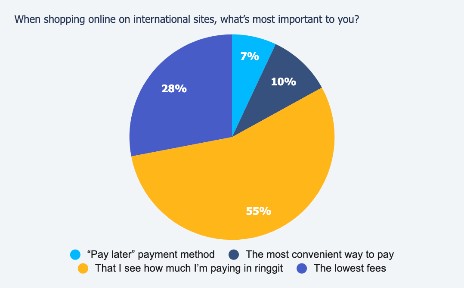
Still, the Financial Controllers are still looking to keep budgets intact and spending on track, as 28% of shoppers noted that whether they are paying the lowest fees is the most important factor of consideration when spending on an international site, and 55% want to know the total cost of the purchase in ringgit.
Importantly, to feel more secure when spending money overseas, Malaysian respondents say they want to know they are protected from fraud (40%), the total amount they have spent (37%), and the exact fees they have to pay (15%).
Lim Paik Wan, Malaysia Country Manager, Wise, said: “As international e-commerce and shopping continues to grow in popularity across the country, Malaysians need solutions that will help them navigate hidden fees and provide an easier way to make international purchases. We know from our research that transparency and convenience are paramount to Malaysian consumers, which is why we’re proud to offer our multi-currency account and card to anyone who needs a better solution for their spending needs. Malaysian shoppers should be able to put their hard earned money toward their purchases, not hidden fees, and we hope they take their financial savvy even further by using Wise.”
The Don’t Kena Con research was conducted from 15 December 2021 to 18 March 2022. It encompasses a sample size of 672 respondents who identify as Malaysian and non-Malaysian. Responses were collected online from the How Wise Are You About Money? Quiz.
About Wise
Wise is a global technology company, building the best way to move money around the world. With the Wise account people and businesses can hold more than 50 currencies, move money between countries and spend money abroad. Huge companies and banks use Wise technology too; an entirely new cross-border payments network that will one day power money without borders for everyone, everywhere. However you use the platform, Wise is on a mission to make your life easier and save you money.
Co-founded by Taavet Hinrikus and Kristo Käärmann, Wise launched in 2011 under its original name TransferWise. It is one of the world’s fastest growing, most profitable tech companies and is listed on the London Stock Exchange under the ticker, WISE.
13 million people and businesses use Wise, which processes over £8 billion in cross-border transactions every month, saving customers over £1 billion a year.
Appendix A: Four money personality types — which one are you?
Shopping Pro
Shopping is always the highlight of your travels abroad. You’re quick to spot the best buys, and even faster to snap them up. You know where the hottest sales are and what cards to swipe with to snag your new favourite buy. Your internet browser has bookmarks of all your favourite shopping sites, and you value speed above all.
Financial Controller
You keep a firm grip on the purse strings. Often the one in charge of money matters in your household, you ensure the bills are paid on time so that the wifi stays connected and Netflix keeps streaming. You’re always on the lookout for financial tools and services that offer convenience and efficiency while helping you to reduce costs.
Aunty Power
Your superpower is seeing through hidden agendas. If a deal sounds too good to be true, you poke and prod until you’re satisfied it’s legit. RM3.99 is RM4.00 lah! You actually read all the terms and conditions and ask as many questions as possible before committing.
Kopitiam Uncle
You look for quality, not Insta-worthy. You don’t go for designer coffee and prefer the humble kopi O from your regular kopitiam. You just want the simple and honest truth — what are you offering me and how much do I need to pay? Your life motto is less frills, more value.
[1] Independent research conducted by Capital Economics in June 2021 for the period between 2015-2020 on fees related to overseas card spend.
[2] These fees include card ownership and miscellaneous fees, transaction fees and exchange rate margin fees.
[3] Yearly average calculated from the total amount on card transaction fees and exchange rate margin fees only on overseas card spend from 2015 to 2020
In the most recent “Making An Impact” podcast episode, Claire Herbert, ESG Manager for Schroders APAC, discusses with Anastasia Petraki, Schroders’ ESG Investment Director, the topic of greenwashing, concerns around this issue, and solutions that address it.
Elaborating on why investors are concerned about greenwashing and the implications of the rise in climate and investment product disclosures in the Asia Pacific, Anastasia Petraki, ESG Investment Investor, Schroders, shared:
“First, if we are talking about greenwashing at an activity or company level, the risk is a misallocation of capital. This means that money intended for sustainable purposes goes to activities that are not really sustainable. This leaves less money for those activities that can create a more sustainable economic system. So, the economy does not progress, which harms confidence in sustainable investing.
Second, if we are talking about greenwashing at an investment product level, then the risk is mis-selling. That is, people buy products that are making promises that they can’t possibly deliver. This is a failure of consumer protection. Indirectly, it also robs sustainable activities of necessary funding.
[Climate and investment product disclosures] have a dual objective here in the Asia Pacific. The first one is to create an environment that makes it easier to channel private investments toward products and services that will make the economy sustainable faster. The second is to help prevent greenwashing.
Regulators and policymakers are making transparency the number one priority for sustainable finance because, similar to investors, they see a lack of common understanding and data as a potential barrier to further growth in the market.”
Adding on to Anastasia’s remarks on disclosures, Claire Herbert, ESG Manager, APAC at Schroders, commented:
“There is also the big question about whether these disclosures and this additional transparency help.
Environmental, Social and Governance cover a broad set of factors, and different metrics will bear different importance depending on the product type you are looking at or the investor’s priorities and preferences. It’s not easy for regulators to decide which metrics to disclose because more information is great. Still, we don’t want to overburden companies and fund managers with administrative disclosures, especially when methodologies and understanding of all of this are still in their early stages.
Even with all the new disclosures, we still see a lack of understanding and trust. Consumer research tends to indicate that retail investors either don’t engage with this information or don’t understand product disclosures and end up looking at the individual underlying holdings as a “shortcut”. So, if you hold company ‘X’ in your fund and I’ve just read an article about a controversy involving company ‘X’, then I might not think you’re sustainable.
In the same vein, many investors turn to third-party ratings as a “second opinion” or to get some external validation on stuff being reported by a company or investment product. If that rating seemingly lines up with what’s being said, then that’s all good, but if not, there is a risk that people assume there’s something wrong with the reporting rather than something wrong with the rating. And let’s not forget here that ratings are just another subjective opinion on ESG, not the be-all and end-all for deciding what is or isn’t sustainable.”
Schroders’ “Making An Impact” podcast series features our thought-leaders sharing their insights on various Environmental, Social and Governance (ESG) investment topics in easily digestible audio content.
All podcast episodes are available on the Schroders website and Spotify.
Is there such a thing as the best investment in Malaysia? Is there an investment vehicle that is suitable for everyone?
But before we begin, let’s first understand what investment is all about.
“Investment is the dedication of an asset to attain an increase in value over a period of time. Investment requires a sacrifice of some present asset, such as time, money, or effort.”
-Wikipedia
We invest in order to grow our money. Because our time is limited where we can only earn an active income in a limited way, investment can unlock this limitation. The earlier we start investing, the bigger the returns in the long run. There are also investment that can give us income in the form of dividend or interest.
I’m sure you have heard of the saying, “High risk, high return”. It means that in order to get a higher return, we need to take higher risk.
So again this begs the question, what is the best investment in Malaysia?
I’m afraid to disappoint you, but the answer is there is none. There’s no such as thing as the best investment in Malaysia.
This is because we are all different. Our age is different, our time horizon is different, our risk tolerance is different and how much capital we have is different from one another.
The same goes with, what’s the best food in Malaysia? Is it nasi lemak? Roti canai? Char kway teow? Everyone will have their own preference.
Even if everyone voted nasi lemak as our best food in Malaysia. But then which nasi lemak? The one in KL? Or in Penang? Or the one in Johor?
What is more important here is that, the so-called best investment in Malaysia is the one that fits our needs. Let’s say we have another 20 years of working life, the investment is more of a long-term game rather than for a quick gain.
For a fresh graduate, he may want an investment that can start with as little as RM100. Which can then slowly increase the amount once he got a better pay.
But for a high net worth investor, he might decide to invest in painting, with the cheapest painting costing upwards of a few thousand Ringgit.
Best Investment In Malaysia
For some, the answer might be in unit trust. Or ETF (exchange-traded fund) or even ASB (Amanah Saham Bumiputera), since the individual might not have the necessary knowledge and skills to select a stock on his own. He does not have the Technical Analysis know-how on when is the best time to buy a stock. Or his risk tolerance is low, can’t even sleep well when his portfolio is in the red.
Whereas an active stock trader will have no problem cutting his losses when things don’t go his way. He accepts that there are risks involved, and follow strictly the trading plan. But for even the best stock trader, surely he would have some investment in property for example, where he can earn a rental income consistently. This would come in handy when he decides to call it a day and live a rather boring life.
Portfolio diversification is crucial, as the popular saying that goes “Don’t put all your eggs in one basket.”
Essentially, we need to be investing in a basket of portfolio, ranging from the lowest risk all the way to the highest risk.
Low risk investments, such as fixed deposit, Amanah Saham Bumiputera (ASB), Amanah Saham Wawasan 2020 (ASW) and Tabung Haji
Medium risk investments, such as unit trust, mutual funds, robo-advisors, ETF and property
High risk investments, such as stocks, futures and crypto
So the answer to the best investment in Malaysia will be different for you and me.
Have you ever wondered about the health status of your vehicle? Sure, we put a lot of thought and emphasis when it comes to our health but what about our four wheels that strive to keep us safe on the road? Just like us, our vehicles also need to undergo regular health checks to ensure it is operating at optimum safety levels at all times.
With the upcoming school holidays and patriotic holidays in August and September – Merdeka Day and Malaysia Day, vehicle health checks are even more crucial before driving off on a road trip with the family or for ‘balik kampung’ journeys. This could potentially save you from being stranded on the highway due to a breakdown or accident, especially when the roads are going to be jam packed with thousands of holiday-goers.
To avoid such inconveniences, here are five basic vehicle health checks that should be done on a regular basis;
1. Always remember your tyres!
Checking the condition of your tyres should be made a habit, no matter a long or short drive, as a tyre in dire condition is a hazard to everyone on the road. Without healthy tyres, drivers may find themselves skidding on a slippery road or even find that the brakes do not grip as well. Aside from ensuring there’s a spare tyre in the boot and checking the tyre’s air pressure, drivers should also check the tyre alignment, thickness of the brake pads as well as the tyre tread.
2. Swish, swish goes the wiper blades
Most drivers would not even think twice about the condition of their wipers, as long as it is still swishing and wiping rain water away. However, the health of wiper blades deteriorates too, especially when parked daily under the humid and hot sun. Look out for these signs and know when to get them changed; the rubber blades are cracked or peeling off, the blades leave streaks on the windshield, there is squeaking and the wiper frame is bent or looks damaged.
3. Signal left or right, are your lights alright?
Every single light on the exterior of the car is equally important and it should be in good working condition at all times. However, it can get a bit tedious when it comes to maintaining the lights because chances are drivers would not even know if one is faulty. Whenever possible, perform a simple check at home to ensure all lights are in good condition. Aside from the headlights, rear lights, and fog lights, other more important lights to note are the indicator lights for switching lanes and brake lights to alert other drivers to slow down.
4. Battery problems?
One of the first signs that the car battery is about to die is when you have trouble getting the car to start. The moment when the car starts chugging or huffing as you turn the ignition on, drive to your mechanic to get those batteries checked and changed if necessary. It is also good to note the lifespan of your battery and make a note of it somewhere in the car or on your phones so that you can remember.
5. Ensure a cooler vehicle for a cooler drive
While checking engine oils, also check the coolant levels in the vehicle as it might trigger a fire when heat cannot escape from the engine bay due to overheating. In simpler words, the engine radiator and cooling systems are what prevents a vehicle from overheating. The most common causes are faulty radiator fan, cooling system leak and low coolant levels. Never remove a radiator cap when the engine is hot as hot liquid could squirt out and injure you. If unsure, it is best to seek professional help at the mechanic.
In addition to performing these routine checks to ensure your vehicle is operating at tip top shape, one other important measure to consider is getting a motor insurance. Similar to how health insurance may potentially save your life and looming medical costs, motor insurance can do the same. It is like a safety net to ensure your motor vehicle, along with the driver and passengers are well covered and insured.
At Liberty Insurance, Private Car EZY Plus – Comprehensive insurance is a holistic coverage plan to get as it doesn’t provide coverage only against own damage and third-party losses but also covers medical expenses, permanent disability or death in the event of an accident on the road and also covers child seat replacement if the seat is damaged due to accident, theft or flood.
In addition to this, you can also buy one of our Bundle add-ons that include coverage on PA for Passengers, Flood Allowance, 24-hours unlimited mileage towing, side mirror damage and others.
Liberty Insurance also offers an efficient claim process with its Liberty Own Damage (OD) Express Claim that is only applicable with its Private Car EZY Plus – Comprehensive plan. Claims can be made via any smart phone and the accident must be reported within 48 hours for express claims disbursement.
To find out more about Liberty Insurance’s Motor Insurance and its claims process, visit www.libertyinsurance.com.my.
A very simple definition of Financial Planning is the process of managing our resources to help us achieve our life goals. Now that we are in the cryptocurrency age, how do embrace crypto in our financial planning?
It is a process which we proactively look at our financial situation and determine the better routes which can allow us to use these resources to help us accomplish what we hope to have to call it a good life.
Many people seem to think that when we have got a financial plan done, we have done financial planning, and hence we can then on our way to become richer, and retire early, or sending our children to study abroad.
The truth is that financial planning is a process but not a touch-and-go activity that produces a document called financial plan. Life is full of changes, so any plan we make today will always be challenged or need to change in response to the actual situation in life.
Financial Wreck Caused By The Pandemic
For instance, no financial plan will have predicted COVID-19 and prepare everyone for the Movement Control Order (MCO) and all the consequences from having these shutdowns in the past two years.
Our money is one of the resources we have that can be used to help us accomplish our goals, and money itself is not the goal.
If our reason to invest in good deals or engage in financial planning conversation is to have more money, this reason itself invites more questions than being an answer.
“More money for what?”
“More money to do what?”
“Why do you need to have more?”
To have more, there’s a trade-off that we must accept.
More Work = More Money = Less Rest
For example, to earn more, one must work more, to work more, it could mean one has to let go of time for rest, or to not spend more time with loved ones, or not able to enjoy activities that they like.
It could also means taking more risk so that we have a potential higher return from our investing activity.
So, in our pursuit for more money, we may fare better if we adopt a big-picture view but not only focus on having more money.
Sometimes, we decide to delay, or postpone doing things we really want or hope to because we are afraid to do it. And often, it is due to our feeling of afraid we don’ that enough to ‘just do it’, or the fear of “cannot afford to”.
This is not abnormal, and I can totally understand this emotion. When we do not know how much we need for the rest of our life, how are we able to feel we have got enough, right?
A good financial planning process is one where we spend more time to understand the person, identify the values (what’s important for this person), then take a look at their money management habit and their net worth (what they have left after minus what they owe), then we can have an idea if this person will have enough money for the rest of their life.
What Are Your Life’s Goals?
This process helps us understand a few important answers, such as:
Do I have to reduce my spending today?
Should I get a side hustle to boost up my income today?
Do I have to take more risk on my investment?
Can I change my car or house without affecting my future?
Can I quit the job I hate and accept a new job with lower pay?
At what age may have a huge cashflow deficit?
At what point (or age) will I run out of money in the future?
If I lose all my investment money today, how bad will my future looks like?
Establishing a good financial planning process can help us to bring our future to the present, and by looking at this future we can assess what are the thing we do not like so that we can make the change to it today.
Imagine having to wait for 20 years only to find out that we will still run out of money at a certain age, versus knowing this scenario is likely to happen 20 years earlier and we have 20 years of time to change something, which route would you prefer to take?
Through proper financial planning, we get a ‘preview’ of our future today, but at the same time, we make some assumptions of what might happen, such as inflation, potential investment return, our spending and potential future income, taxes, etc.
Hence, one of the things we will be thinking about is where or how should we allocate our money, to what kind of asset classes. And nowadays, it is likely most people have heard of and are quite keen to understand where cryptocurrency or crypto assets can fit into their plan.
Dawn Of The Crypto Age
Before the emergence of crypto assets, people have allocated their savings to various types of asset classes like stocks, debts, some keep most of their savings in cash or cash equivalent, businesses, real estates, arts, collectibles, gold or silver, to name a few.
Some of the assets have a low risk and value tend to not fluctuate too much and are ‘predictable’, while some the value may deviate quite a lot, and are considered ‘risky’.
One of the key considerations in determining our asset allocation, is to understand if we need the investment to generate additional income, or to have the value increase in future for us to have ‘gain’.
Essentially, crypto assets are assets that are non-income generating but more for the investment objective for capital gain.
While it is undeniable that crypto currency has helped make many new millionaires, for this wealth to be sustained into the future, one may want to explore how this new wealth can be protected or kept, so that even if the value of the asset class reverses its course, this person will not be knocked back to the ‘pre-crypto’ life.
Of course, it is perfectly fine if we remain having our 100% of our wealth be invested in crypto assets. However, that will also mean we tie our future financial health and possibility in life to a single asset class.
Imagine a person putting all their savings for old age to the stock of the single company they work at, and over the course of years for whatever reason, this company went out of business, or the company’s business dropped a lot due to new competition, or innovation.
The above example is not just pure imagination, we have seen a few big company’s gone through such trajectory before. Will this person be better off ‘putting all the eggs in different basket’ instead of ‘in the only basket’?
It does not matter what asset classes we are thinking about, it seems that it is not a bad idea to limit our downside risk and avoid over-concentration.
What about people who have not experienced the explosive growth or have not invested in crypto assets before?
Diversification Is Key
Generally, crypto assets or digital assets are one new asset class for us to incorporate to our personal investment portfolio to achieve diversification beyond the common asset classes mentioned above.
Depending on your tolerance for risk, and your investment objective, you will then understand how expose you can be, just like on every other asset classes. A person who is conservative or cannot sleep well even with a small up and down may want to limit exposure to volatile asset class, regarding the potential upside, and vice versa.
For asset class that can have a large swing in value, non-income-generating, it is advisable that we limit our exposure and do not over commit our wealth to it.
However, if one decides to do so, it will be prudent to ensure that we have prepare sufficient savings that can offer us liquidity and peace of mind during challenging time in life, or when the asset value is not at a good level for us to make withdrawal.
It is also very important that people only invest into cryptocurrency via digital assets exchanges that are operated by operators approved by Securities Commission Malaysia [1]. This ensures your investment will not fall into schemes that are unregulated or hands of scammer.
Regardless of what we do with our money, it is important that we understand why we want to do certain thing, and how this fit into the overall big picture of our life. By having a proper asset allocation that can support our future and lifestyle, we can avoid overexpose to certain asset classes, or certain asset.
A good financial planning process is about setting a good foundation, and manage our risk, so that we can increase our chance of living a life we consider well lived.
I have over the last couple of years worked with entrepreneurs in start-up businesses. The one thing that continually stands out is that most of my clients do not consider the “legal aspects” as an important facet to their business. If they do seek advice, it may sometimes appear as if the advice expected is a quick solution to a long-term problem, which is never good for any type of business. That’s why it is important to know some of the legal tips, especially for start-ups.
Most start-up entrepreneurs use the reason that legal advice is costly and as such, it is an expenditure they do not want to invest in. I can assure you that once legal proceedings are initiated against you either personally or against your company, the cost you would incur in getting good legal counsel would be a lot more than what you may be incurring now.
In the long run, the fees will be higher, and the process a lot more time-consuming and protracted. It will be a detrimental lesson to learn. My advice is to always be aware of your legal rights and duties under the Companies Act 2016 if you wish to be in business.
I have always said that laying the foundation right from the beginning is key to any successful business. Here are legal tips, where you have to yourself these questions if you are in the start-up business or wish to start one:
1. Do I Have Partnership And/Or Founder Agreement In Place?
Oftentimes, people get so excited about a business plan that they forget to discuss the nitty-gritty. It is important to have regular meetings with your co-founders or investors about the terms of your partnership.
Some questions you may wish to ask and set out clearly in your partnership and/or founder agreement are:
What are your specific roles and responsibilities as founders?
What if one founder wishes to exit? What happens to his shares?
What is the agreed percentage that each founder will get?
What are the overall goals and expectations for the business?
What are the consequences if the founders do not hit their specific KPIs?
What are the pay-outs for allowances, dividends or salaries for co-founders?
2. Will The Start-up Be Registered As A Private Limited Company, Enterprise Or A Limited Liability Partnership?
This question is pivotal as there are tax implications as well as other accounting and auditing requirements that the start-up will need to comply with. Over and above that, personal liabilities of the partners and founders will also need to be considered.
For example, if an enterprise is set up, then there will be personal liability involved as opposed to a private limited company, where the company will take on that liability as a legal entity.
Do speak to your lawyer and accountant on a structure that would best suit you and your business.
3. Employment Issues
Image of business documents, pen and glasses on workplace during meeting of partners
Having employment contracts in place for the people you hire whether they are freelancers or full-time employees is vital. This will reduce the risk of having a labour court dispute arise in the event you wish to terminate a particular employee who is not performing as expected.
Do ensure that your employment contracts have a confidentiality clause that binds your employees so as to ensure that your client and your confidential information are not divulged or disseminated to any third party.
4. Data Protection Matters
When your start-up business involves managing someone else’s personal data, there are legal standards that you must comply with in managing and handling such personal data. For example, obtaining the consent of the Data Subjects before you obtain their personal data, storing of the said personal data, giving access of the personal data you have in your possession to the Data Subjects when they ask for it.
Recently, the Personal Data Protection Commissioner has indicated her intention to carry out inspection on data users that are not registered or not required to be registered under the Personal Data Protection Act in order to ensure compliance with the general provisions of the Act as well as the minimum security, retention and data integrity standards set out under the Personal Data Protection Standards 2015.
5. Intellectual Property Matters
It is important to check with the Intellectual Property Corporation of Malaysia (“MyIPO”) whether some other company or person has already trademarked your startup business name. Please do the necessary searches to ensure that you are not using someone else’s business name or logo. This will ultimately relieve you of any hassle of being sued for trademark infringement.
And what a pity that would be if you have already gained traction in your startup business and people are starting to recognise your brand name not to mention the unnecessary legal cost of having to defend a suit for trademark infringement.
What I have set out here are just a few of the areas you may wish to consider in your own startup business. However, each and every business will have different needs or requirements so it would be best to speak to a legal advisor on setting your foundation right.
Even if you are already a successful start-up, I believe it is never too late to do a legal audit to check if everything has been set right, to avoid any unnecessary legal repercussions.
About the author
SHARMILA RAVENDRAN is the founder of the law firm, Messrs Ravindran located in Mont Kiara, Kuala Lumpur. She has more than 14 years of experience in the legal industry servicing clients that include local and foreign companies. She is now actively involved in corporate advisory work and commercial litigation and is a Panel Adjudicator with the Kuala Lumpur Regional Centre for Arbitration. She also sits on the Bar Council Child Rights Committee and is the Legal Director for Lean in Malaysia. She can be contacted at sharm@ravindran.com.my.
Debt, in essence, is all about borrowing money from a third party, and having the means to pay it back. Debt is not always bad news; it really depends on the kind of debt you currently have and your ability to pay it back. Let’s take a closer look at ‘good debt vs bad debt’.
Therefore, let’s start off with a self-assessment on debt. Referring to Table 1, kindly answer the statements with a “yes” or “no”. The more “no” in your replies, the higher your stress level in debt management.
1
My monthly loan servicing ratio over my monthly income is about 38% or below.
2
I am only investing my free money and never borrow to invest.
3
I have consistently (monthly) and/or fully paid my credit card debts.
4
I keep a track of my total debts annually and it is decreasing over the years.
5
I know the difference between good and bad debt, and only utilise the good debt to acquire appreciating assets like property.
6
I pay all my household bills on time.
7
I am current on all my debt payments.
8
I know who to look for help if any of my family members r I are in deep debt.
9
I know the risks of becoming a guarantor, co-loan owner and supplementary credit card owner.
10
I know the interest rate of each loan that I borrowed, and how the interest is charged on the loan amount.
11
I know how to restructure my debt wisely if needed, and clear the loan with the highest interest rate first.
Table 1: Self-Assessment
Good Devt VS Bad Debt?
Did you know that debts can be categorised as “good” or “bad”? Good debts refer to the ones with low-interest rates (below 8%), and your borrowing is used to purchase appreciating assets such as residential or commercial properties, or investing in a business.
A study on Malaysian property valuation between 1991 and 2014 showed that the compound annual growth rate (CAGR) for overall property in Malaysia is around 5.97%。No doubt that property is an appreciating asset, still location is key for greater return.
Bad debt, on the other hand, is akin to borrowing money to buy a car, which is a depreciating asset, although the loan interest rate is considerably not high (around 4-6%). Every year, the car value will drop at an average of 10%.
From Table 2, it is crystal clear that we shouldn’t borrow if the interest rate is more than 8%.
Debt Type
Average Interest Rate (Annual)
Illegal Shark Loan
60%
Credit Card
15-18%
Personal Loan
10-12% (Promotional 8.88%-9.99%)
Education Loan
8-10%
House Loan
4.5-6.5%
Car Loan
4-6%
PTPTN
1% (3% is the old rate)
Table 2: Types of Debt and Average Interest Rate (Annually)
Words Of Advice
Healthy Debt Ratio – A key indicator on whether you have a healthy debt ratio is the Monthly Debt Servicing Over Monthly Income Ratio. It simply totals up your monthly debt repayment amount over your monthly income.
This ratio should always be kept below 40% at all times, though a temporary spike is still acceptable. For those far below 40%, you have more room to gear on appreciating assets resulting in easier loan approvals.
Never Borrow to Invest – The first rule of financial planning is not borrowing to invest, even in share margin investment, where the interest rate is low at about 4%.
We should only invest free money. Don’t borrow money even from family members, relatives or friends to invest. Otherwise, it could cost you both money and relationship.
Get the Longest Loan Period (if possible) – Forget affordability, will you apply for a 25-year loan (instalment: RM2,400) or 35-year loan (instalment: RM1,200) for a property purchase?
Choosing 35 is a wiser strategy to deal with loan and cash flow. Even if you opt to pay RM2,400 (instead of RM1,200) monthly and consistently, the loan will end in 25 years.
However, if you select the 25-year package, there is no way you can reduce your monthly repayment if you have cash flow problems in certain months.
In the event you don’t pay consistently, banks will increase the interest rate causing the repayment amount to rise, lesser free cash in hand, and a whole lot more stress!
If non-repayment continues for two months or more, you will be seen as failing to service your home loan, and worse, the bank might even auction your house. Therefore, why risk your financial position with a shorter period of loan which offers lesser flexibility?
The longer the tenure of your home loan, you would have more cash in hand to actively invest into an investment instrument that can give you an annual return of more than 6%. This is smart financial planning.
About the Author
This article is written by Yong Chu Eu. He is the Founder, Principal, MFPC Shariah RFP, CPD/CPE, HRDF Certified Corporate Trainer of Money & Life, Financial Book Author, Licensed Financial Planner, E2E Financial Literacy Principal Coach & Local Media Guest.
The following story is based on an actual series of events with some names and circumstances fictionalised and any similarity to the name, character or history of any person is entirely coincidental and unintentional. Hopefully we can understand the importance of succession planning and make the necessary preparation.
Elder Tan put down his chopsticks, looked up and smiled.
His three sons and their spouses are seated together once again for a reunion dinner which the COVID-19 pandemic denied the family for two consecutive years. In the next table, the children are noisily tucking in their food and chattering away as well as occasionally peering into each other’s phones.
Tan was a picture of contentment. He has raised his children well to be successful in their own right. He is proud of his eldest son Seong who is doing a good job taking charge of the hardware business that Tan had built from scratch. Danny, the No 2, is head of the engineering department in a construction firm while Chye, his street smart youngest son, is doing well in sales in his father-in-law’s spare parts company.
“I want to tell all of you something…” Elder Tan interrupted the conversations at the reunion gathering.”
Succession Planning Is About Being Prepared
I want to retire and leave the family business to Seong,” he added. Seong looked at his father, beaming that he is getting just rewards for the hardwork that he had put in to run the business.
“I’ll transfer the shares of the company to all three of you equally,” Tan said looking at his three sons. The expression in Seong changed on hearing that. He looked startled as he had expected the lion share for all his sweat, literally!
“Equally with Danny and Chye! They didn’t lift a finger to help out in the business! And they now get equal share of the fruits of my toil? No way!!!” Seong now getting red faced with anger.
He rose from his seat and smart-mouth Chye stopped him in his tracks with his remark: “What, you’re not happy?”
The whole atmosphere changed as Seong lunged towards Chye. Danny stepped in between and after that, chaos broke out. A breakdown in family harmony over too-soon, unforeseen, unexpected equitable or inequitable distribution of family assets?
Tan’s desire to be fair and thus, the equitable distribution of equity in the family business probably blindsided him from the possibility of a family feud erupting from it. Estate planning and succession planning needs to be skillfully handled and prudently managed to avert any unwarranted situation such as a family feud.
Succession planning inevitably is critical for business, especially family-owned business. Business owners tend to underestimate and downplay its importance, ignoring possible downsides when they are no longer in charge. It holds true that failing to plan is planning to fail.
A pre-planned succession such as through a Family Business Trust or a Family Foundation would be a prudent way to lay down instructions on conditions for ownership succession, management succession and rewards and conveyed impartially and professionally by an independent third-party such as a trustee would avert family feuds over inheritance.
Three key areas need to be considered in setting up a business succession plan namely:
Ownership Succession. This will ensure that the shares of the family business will be protected and not likely to be fragmented over generations. The rightful heirs are clearly defined, thus enabling ring fencing against outsiders to own the family business
Management Succession. Successor is crucial for continuity of the family business. By having a capable candidate to be successor of the family business, it retains the goodwill of the family business and it improves the confidence of the investors, customers, and employees
Family Wealth Management. Proper planning and allocation of family resources effectively will maximise the benefit for each of the family members, such as in areas of financing family education, family medical and family reserves needs
Business succession planning is an essential part of the risk planning for the business.
About Rockwills International Group
Rockwills International Group, now in its 27th year, pioneered professional will writing in 1995 and has since evolved into the leading estate planning specialist in the country. It is today the largest provider of solutions and support services in the areas of trusts, succession, management and distribution of wealth. It has shareholders’ funds exceeding RM50 million. It has done over 280,000 wills and 15,000 trusts and hold more than RM25 billion in assets under trust.
Get every print issue delivered to your door — fill in your details below to subscribe or renew.
Terms & Conditions and Notice
Terms & Conditions:
No refund policy: all sales are final, please review your order before confirming. We do not offer refunds or exchanges for any products sold through Inovatif Media Asia (IMA), the publisher of The SmartInvestor magazine.
Price subjected to change at Management's discretion.
IMA is not responsible for delays or delivery failures.
Print subscription for overseas readers are subjected to additional delivery charges.
Additional charges apply for courier services.
NOTICE:
IMA has not appointed any sales representatives; all purchases must be made directly by emailing my-circulation@inovatif.com.my. We are not responsible for any transactions made through unauthorised channels.
Please also check with us on the retail price of our magazines if you have not received our renewal/subscription form, before making any payments.